The Scenic Route and the Express Lane
A Practical Framework for Enterprise Agentic AI Adoption
How APMN enables incremental, governed, risk-calibrated AI transition across Financial Services and Healthcare
Published by Kshetra Studio Pty Ltd · APMN Specification v0.1 - Apache 2.0 · apmn.kshetra.studio
Executive Summary
Enterprise organisations are sitting on a paradox. The agentic AI frameworks available today are technically mature, production-ready, and capable of transforming the most complex and high-value business processes in financial services, healthcare, and beyond. Proof of concepts are working. The capability exists. And yet production deployments at enterprise scale are not happening at the rate the investment warrants. The reason is not the technology; it is the absence of a shared language between the people who build agentic workflows and the people who must approve them.
Risk committees, compliance officers, and enterprise governance structures approve process flows. They approve structured visual representations of how a business process works, where human judgment is applied, what the fallback is when something goes wrong, and how the organisation knows the process is performing as expected. These are not unreasonable requirements. They are the governance foundations that regulated industries have built over decades, encoded in BPMN-compatible process diagrams that boards, regulators, and auditors have learned to read and trust. Agentic AI frameworks do not produce these artefacts. They produce code, and code is not something a risk committee can approve, a compliance officer can certify, or a regulator can audit without a significant translation step that introduces delay, ambiguity, and drift between what was approved and what was deployed.
APMN, the AI Process Model and Notation, is the missing translation layer. It extends BPMN 2.0 with AI-native constructs: confidence gates that make probabilistic routing visible and negotiable at design time, escape gates that provide structural fallback guarantees, human-in-loop tasks with defined timeout behaviour and escalation paths, and observability hooks designed into the workflow from the first diagram rather than bolted on after deployment. The result is a notation that enterprise governance committees can read, challenge, and sign off on, and that compiles directly to the execution frameworks developers are already using, including LangGraph, Orkes Conductor, and Temporal. The diagram the risk committee approves and the scaffolding the developer implements are derived from the same source, so what was approved is what runs.
This white paper shows what that journey looks like in practice, across mortgage origination in financial services and clinical prior authorisation in healthcare, and across four horizons of incremental AI adoption that any enterprise can begin today at whatever pace its risk appetite and regulatory environment allows.
Section 1: Why Enterprise AI Adoption Stalls
The Paradox of the Capable Framework
Something unusual is happening in enterprise AI adoption. The execution frameworks are mature. LangGraph, Orkes Conductor, and their peers can orchestrate sophisticated multi-agent workflows with reliability and scale that would have seemed ambitious two years ago. The models are capable, the tooling is production-ready, and the proof of concepts work.
And yet the deployments are not happening at the scale the capability warrants.
Enterprise AI programmes are completing proof of concepts and stalling before production. Agentic workflows are demonstrating value in sandboxes and sitting in pilots for twelve months without progressing. Organisations with genuine AI ambition and adequate budget are not deploying at the rate their investment in proof of concepts would predict.
This is a translation problem, not a technology problem. And the thing being lost in translation is not technical detail; it is institutional trust.
Two Worlds With No Common Language
Enterprise organisations operate in two distinct worlds simultaneously, and the distance between them is larger than most AI programme teams appreciate.
The first is the world of execution: developers, data scientists, and AI engineers building agentic workflows in Python, YAML, graph definitions, vector databases, and model APIs. This world moves fast and speaks in abstractions that are precise, powerful, and completely illegible to anyone outside it.
The second is the world of governance: risk committees, compliance officers, chief risk officers, general counsels, and board audit committees working with process flows, policy documents, risk assessments, audit trails, and sign-off matrices. This world moves deliberately and speaks in abstractions that are structured, auditable, and completely disconnected from what the execution world produces.
These two worlds have always existed in enterprise technology. For decades the gap between them was bridged by a shared artefact: the business process diagram. A process diagram drawn in BPMN notation could be read by a business analyst, reviewed by a risk committee, approved by a compliance officer, and handed to a developer who could implement it. The diagram was not the code, but it was a faithful enough representation of the intended behaviour that governance and execution could share it as a common reference.
That bridge broke when AI entered the workflow.
Why AI Broke the Bridge
A traditional BPMN process diagram describes deterministic behaviour. Every gateway has a defined condition, every task has a defined outcome, and every path through the workflow is knowable in advance. A risk committee reviewing a BPMN diagram can trace every possible path from start to end and understand exactly what the process does in every scenario.
An agentic workflow does not behave deterministically. An LLM reasoning node produces a probable output, not a defined one. A confidence score measures how reliable that output is likely to be but does not guarantee the outcome. A retrieval step returns the most relevant documents given a query at the moment of retrieval, against the current state of a vector store that may have been updated since the workflow was designed.
This probabilistic behaviour is the source of agentic AI's power, not a deficiency. An AI agent that can reason across ambiguous inputs, retrieve relevant context dynamically, and handle novel cases without explicit programming is doing something no deterministic rule engine can do.
But it creates a governance problem that has not been solved. A risk committee cannot approve a workflow it cannot trace. An auditor cannot certify a process that produces different outputs for the same inputs depending on model confidence and retrieval results. A compliance officer cannot sign off on an AI step that cannot explain, in terms they can verify, what it will do when confidence is borderline.
The execution framework does not solve this problem. LangGraph is a brilliant tool for building and running agentic workflows, but it was not designed to be read by a risk committee. Orkes Conductor is a powerful orchestration engine for enterprise-grade workflow execution, but it was not designed to be approved in a board paper. These are correct design choices because these frameworks are optimised for developer productivity and execution reliability; governance legibility is a different problem.
The result is a gap. The AI engineer has a working workflow that demonstrates value. The risk committee has a governance requirement it cannot fulfil from the artefacts the engineer produces. The programme stalls.
The Cost of the Gap
The cost of this gap goes beyond delayed deployment. It is a structural misalignment between where AI investment is going and where AI value is concentrated.
Developer-adopted AI frameworks are monetising at the tool layer, with technical buyers, usage-based pricing, and individual developer or small team adoption. The value captured is real but it is a fraction of what is available.
The enterprise layer is where the large programme budgets live, with multi-year contracts, business buyers, and governance-based procurement. Camunda commands this layer for process orchestration because its BPMN-based notation speaks the language of enterprise governance. Appian commands it for low-code workflow automation for the same reason. These platforms are not technically superior to the developer-first frameworks; they are governance-legible in a way that developer-first frameworks are not.
The gap between tool-layer adoption and enterprise-layer adoption is a language gap, and a language gap is solved by a translator, not by making the execution framework more capable.
What the Translator Needs to Do
The translator between enterprise governance and agentic AI execution needs to satisfy three requirements simultaneously.
First, it needs to speak the visual language that enterprise governance already trusts. BPMN has been the notation language of enterprise process governance for two decades. Risk committees, compliance officers, and enterprise architects have built their approval processes around BPMN diagrams. A new notation that requires them to learn a new visual language will not be adopted regardless of its technical merits. The translator must be BPMN-compatible.
Second, it needs to represent the constructs that make agentic AI distinctive: confidence thresholds, probabilistic routing, human oversight at defined points, structured fallback when AI cannot proceed, and audit trail hooks designed into the workflow rather than bolted on after deployment. These constructs do not exist in standard BPMN because BPMN was designed for deterministic processes. The translator must extend BPMN with AI-native constructs that governance committees can read and reason about.
Third, it needs to compile to the execution frameworks that developers are already using. A notation that requires developers to abandon their existing toolchain will not be adopted regardless of its governance merits. The translator must sit above the execution frameworks, not replace them, so the same source that the governance committee reviews produces the scaffold that the developer implements.
A notation that satisfies all three requirements is the missing artefact that enterprise AI adoption has been waiting for.
Section 2: The Scenic Route and the Express Lane
A Pattern for Incremental Enterprise AI Adoption
Every enterprise AI programme eventually confronts the same tension.
The business cannot afford to stop. The processes running today, however manual and however slow, encode years of edge cases, regulatory responses, and hard-won operational knowledge. A mortgage origination workflow at a major bank has absorbed a decade of exception handling. A clinical prior authorisation process at a hospital network reflects years of compliance refinement. These are not inefficient processes waiting to be replaced; they are institutional memory in executable form.
At the same time, the business cannot afford to stand still. The capability gap between what AI can do today and what these processes currently do manually is large, visible, and growing. The question is not whether to move but how to move without breaking what already works.
The answer most enterprise programmes reach for is the big bang: design a new AI-native workflow, run a proof of concept, get approval, migrate. This approach fails more often than it succeeds, not because the technology is wrong but because the approval never comes. A risk committee cannot sign off on replacing a proven process with an unproven one, and the fallback if AI fails is not a config change; it is a crisis.
The Scenic Route and Express Lane pattern exists because enterprises do not need to choose between the big bang and standing still. They need a third option: running both simultaneously, with explicit control over which one carries the load at any given moment.
The Pattern Defined
The Scenic Route is the existing proven process, with every edge case handled, every integration tested, and every regulatory requirement satisfied. It runs end-to-end and the business relies on it completely.
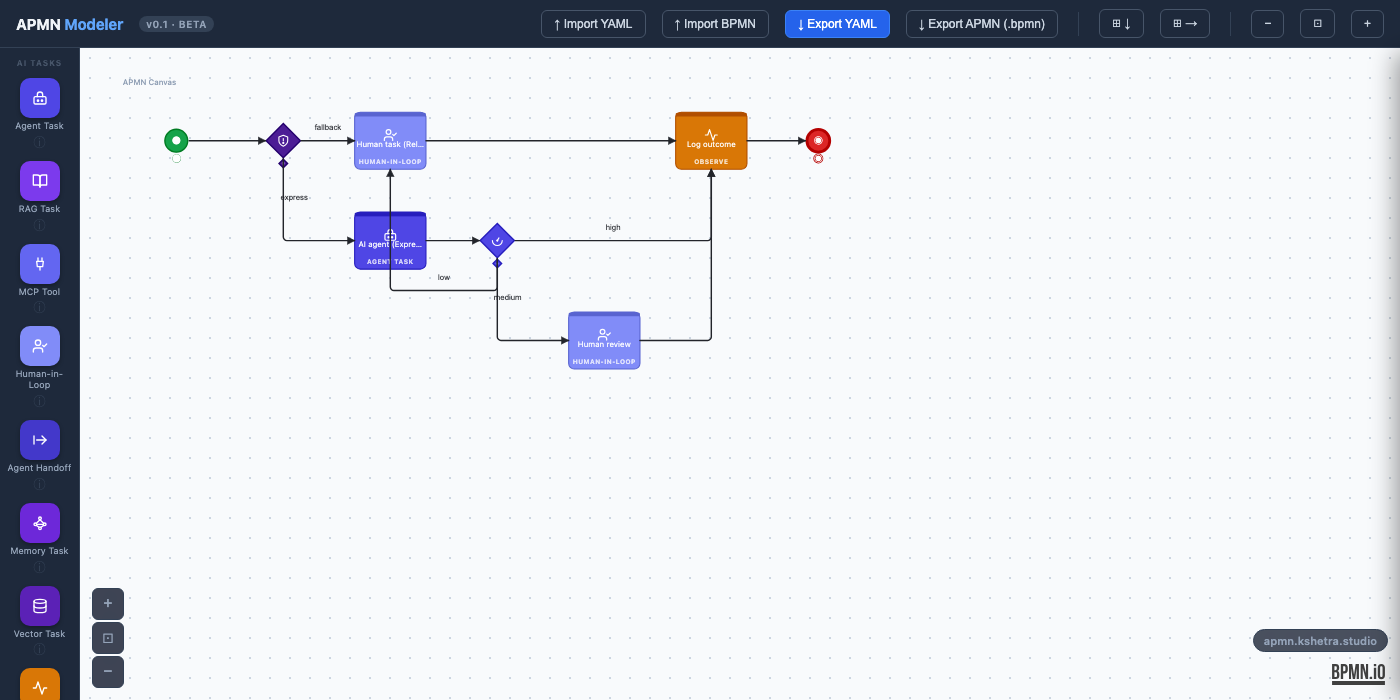
The Express Lane is the AI-augmented path running in parallel, faster and smarter but not yet trusted with everything. It handles a defined subset of cases, specifically the ones where confidence is high and the consequence of an error is recoverable.
On-ramps connect the Scenic Route to the Express Lane at specific decision points. A case that meets the confidence threshold enters the Express Lane; a case that does not stays on the Scenic Route.
Off-ramps return cases from the Express Lane to the Scenic Route when AI confidence drops, when a step fails, or when a human reviewer decides the case needs the proven path. The off-ramp is the safety net that makes the Express Lane possible.
The business never stops running. The Scenic Route carries the full load on day one. The Express Lane proves itself node by node. Over time, as confidence builds and track record accumulates, more cases move to the Express Lane. Eventually the Scenic Route becomes the exception path, a national park of sorts: still there, still reliable, visited by the edge cases that need it.
Why This Is Not Just a Technical Pattern
The Scenic Route and Express Lane is a governance framework before it is an engineering one.
The on-ramps and off-ramps are controlled by confidence thresholds that are negotiated decisions, not engineering defaults set in a config file. They are made by the people accountable for the process: the risk committee, the compliance officer, the business owner.
At Horizon 1, a bank's credit risk committee might set the Express Lane threshold at 0.95 so that only cases where AI confidence is extremely high enter the Express Lane while the Scenic Route carries everything else. That is a conservative but rational starting point that allows the bank to begin building a track record without material exposure.
As the track record builds, the same committee can lower the threshold to 0.85 and then 0.75, expanding the Express Lane's share of cases incrementally. Each threshold change is a governance decision rather than a code change. It belongs in the process design, visible to the people accountable for it, not buried in a developer's configuration file.
This is precisely what APMN enables. The confidence threshold is a property of the confidenceGate node in the APMN source. It is visible in the diagram, can be reviewed, challenged, and adjusted by the risk committee without touching the implementation, and when it changes the change is in version control alongside the business decision that drove it.
The Four Horizons of Enterprise AI Adoption
The Scenic Route and Express Lane pattern enables an incremental journey across four horizons, each representing a different balance between proven process and AI capability.
| Horizon | Name | Express Lane Scope | HITL Role | Scenic Route Role |
|---|---|---|---|---|
| 1 | Prove Points | One narrow sub-task, full HITL backup | Mandatory review of every AI output | Primary path for all cases |
| 2 | Low Hanging Fruits | Multiple proven sub-tasks | Exception-triggered on medium confidence | Primary path for sub-threshold cases |
| 3 | Assisted Game Changers | Complex reasoning at scale, full workflow redesign for chosen sub-processes | Exception handler for edge cases and low confidence | Defined scope of cases kept on human-primary path |
| 4 | Self-Improving Processes | Majority of volume, continuous model improvement via ModelVersionGate | Override and escalation only | Exception path for complex and high-risk cases |
Horizon 1 - Prove Points: The Express Lane handles one narrow, well-bounded sub-task where AI confidence is high, the consequence of error is recoverable, and HITL backup is present for every AI node. The Scenic Route is primary.
Horizon 2 - Low Hanging Fruits: Multiple proven sub-use cases run in the Express Lane. HITL is still present but increasingly as an exception rather than a rule on the proven paths, and confidence thresholds are renegotiated as the track record builds.
Horizon 3 - Assisted Game Changers: AI handles complex reasoning tasks at scale with structured human oversight at defined checkpoints. Full workflow redesign is possible for chosen sub-processes, and the Express Lane carries the majority of volume on proven paths.
Horizon 4 - Self-Improving, Objective-Driven Processes: AI nodes expand through the workflow driven by measured outcomes. The modelVersionGate runs A/B tests between model versions in production, the observeEvent feeds structured telemetry back into the continuous improvement loop, and the Scenic Route has become the exception path for sub-processes AI has proven itself on.
What APMN Adds to This Pattern
Developers have been building parallel run architectures for years using feature flags, shadow mode deployments, and canary releases, so the Scenic Route and Express Lane pattern can be implemented without APMN. What APMN adds is governance visibility.
Without APMN, the confidence thresholds live in a config file, the on-ramp logic lives in Python, and the off-ramp conditions live in a developer's memory. The risk committee cannot see any of it. The approval is based on a PowerPoint that drifted from the implementation two sprints ago.
With APMN, the entire pattern is visible in a single diagram. The confidenceGate shows the threshold and the three routing paths. The escapeGate shows the off-ramp conditions and where they route. The humanInLoopTask shows where human oversight sits and what the timeout behaviour is. The observeEvent shows what is being logged and to where.
A risk committee can review this diagram and answer the questions that matter to them: Where does the AI make decisions? What happens when confidence is insufficient? Who reviews edge cases and within what timeframe? What is the fallback if a step fails? How do we know the Express Lane is performing as expected?
Every answer is in the diagram, not in a separate document or a developer's head, but in the same source that compiles to the execution framework.
Section 3: FSI in Practice - Mortgage Origination Across Four Horizons
Why Mortgage Origination
The figures used in this section are illustrative, based on patterns observed across enterprise AI programmes. They are intended to make the governance conversation concrete, not to represent the results of any specific organisation.
Mortgage origination is one of the most process-intensive workflows in financial services. A single application moves through credit assessment, identity verification, affordability analysis, property valuation, document collection, compliance checking, and settlement coordination, with regulatory requirements and hard-won exception paths at every step.
It is also one of the highest-value workflows an FSI organisation runs. The difference between a three-day origination process and a three-hour one is not just operational efficiency; it is a competitive advantage that determines which customers a bank can win and retain.
For both reasons, mortgage origination is exactly the kind of workflow where the Scenic Route and Express Lane pattern matters most. The stakes are too high for a big bang replacement and the opportunity is too large to ignore.
Horizon 1: The First Prove Point
The bank identifies credit bureau data interpretation as the first Express Lane candidate: a well-bounded task with clear inputs and outputs where the AI's reasoning can be checked against the human analyst's conclusion before it influences any decision.
The risk committee sets the confidenceGate threshold at 0.92. A single agentTask node is inserted before the human credit analyst step. Above threshold, the bureau interpretation proceeds to the affordability model with the AI output as input and with mandatory human review. Below threshold, the application routes directly to the human credit analyst, unchanged from the Scenic Route.
An escapeGate watches the AI node, routing any failure or timeout immediately to the human analyst. An observeEvent logs every AI interpretation alongside the human analyst's final assessment, building the data that will power Horizon 2.
Six months of data shows 94% accuracy above the 0.92 threshold. The committee approves a reduction to 0.87, expanding Express Lane volume from 31% to 58%.
Horizon 2: Low Hanging Fruits at Scale
Three additional nodes enter the Express Lane: document completeness checking, identity verification, and initial affordability pre-screening. The risk committee negotiates separate thresholds for each:
- Document completeness: 0.88
- Identity verification: 0.95 (higher threshold, since identity fraud carries material consequence)
- Affordability pre-screening: 0.85 (preliminary only, with full assessment still running downstream)
For the first time, AI operates without mandatory HITL review on the high-confidence path for some nodes. Human review is triggered only in the medium-confidence band or when an escape gate fires. observeEvent nodes feed a model monitoring platform with agreed drift thresholds that trigger automatic governance review if accuracy drops.
Horizon 3: The Assisted Game Changer
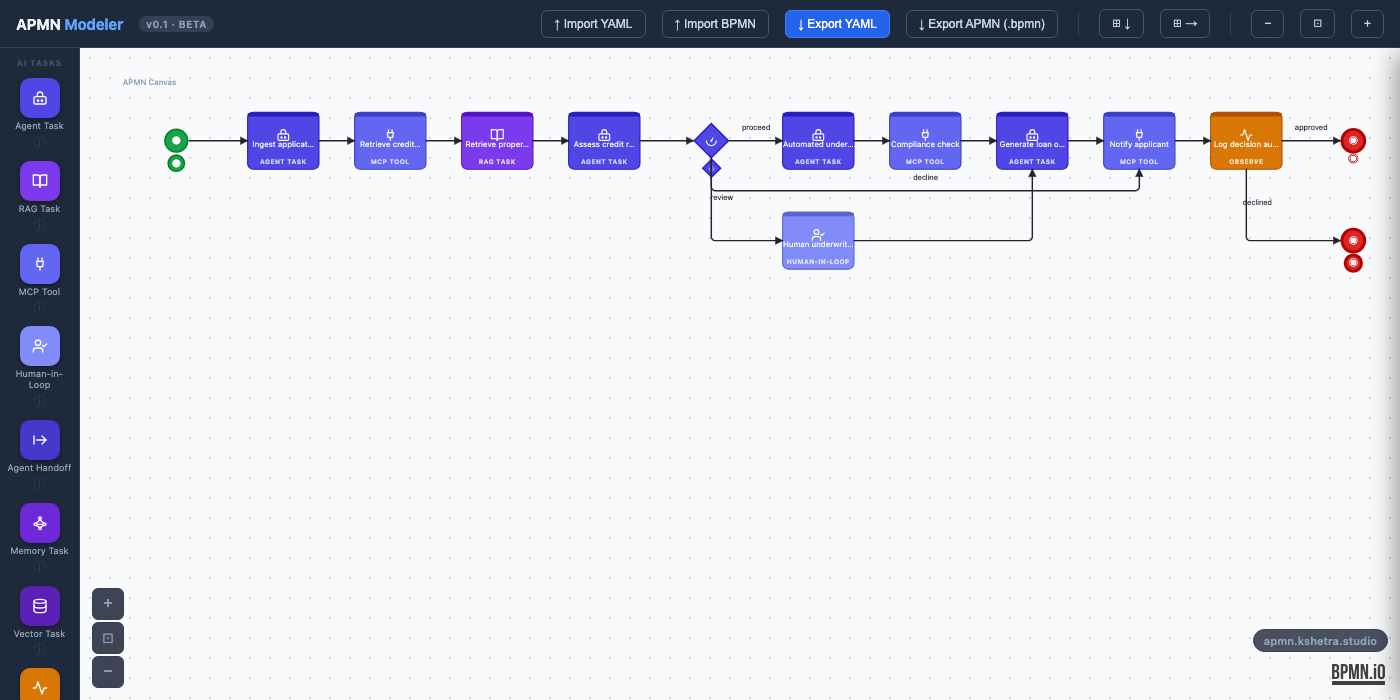
The bank redesigns credit assessment for standard residential mortgage applications below 80% LVR around an AI-first model. The credit analyst's role shifts from producing assessments to reviewing and overriding exceptions.
Several new APMN constructs earn their place here:
- A
ragTaskretrieves current credit policy before assessment so the model reasons against today's policy rather than training data alone. - An
agentHandoffdelegates complex affordability scenarios to a specialist sub-agent. - A
modelVersionGateruns a controlled A/B test between the current model and a challenger on 10% of cases, with the risk committee reviewing results quarterly.
Investment properties, high LVR applications, and applications with negative bureau markers stay on the Scenic Route, not because AI has failed but because the bank has deliberately chosen not to deploy AI there yet. That boundary is explicit in the diagram, so a regulator can read exactly which applications AI touches and which it does not.
Horizon 4: The Self-Improving System
memoryTask nodes persist context across workflow turns so a returning customer does not restart from scratch. observeEvent nodes feed the bank's enterprise analytics dashboard, the governance artefact built from telemetry designed in at Horizon 1. The modelVersionGate is now a continuous improvement mechanism rather than an experiment.
The Scenic Route at Horizon 4 carries complex self-employed applications, commercial property, and unusual income structures. These are deliberate choices rather than failures, and they are the starting point for the next wave of Express Lane expansion as the bank trains specialist models on exactly these cases.
The journey does not end at Horizon 4; it resets at Horizon 1 for the next sub-process.
Section 4: Healthcare in Practice - The Appetite Constraint
A Different Kind of Fallback
In financial services, a wrong AI decision is recoverable. A miscalculated affordability assessment can be caught at review, and a credit decision that turns out to be wrong has a remediation path. The consequence is financial.
In healthcare, the fallback differs in kind, not just in degree. A wrong AI decision in a clinical workflow can delay treatment, affect a diagnosis, or in the most serious cases contribute to patient harm.
This is not a reason to exclude AI from healthcare, where the opportunity is enormous. Manual prior authorisation by phone and fax, clinicians spending a third of their time on documentation, imaging backlogs measured in weeks: these are problems AI can address meaningfully.
It is a reason to be precise about where AI belongs, what role it plays at each horizon, and what the human's role is at every step. In a sector where CMS and NCQA require documented decision rationale and clinical governance committees must approve AI deployment at each stage, the ability to show a committee exactly what AI does, where human oversight sits, and what the fallback is goes beyond a governance nicety. It is a regulatory requirement.
The Low Hanging Fruits
Four areas stand out as genuine Horizon 1 and Horizon 2 deployments available today.
Auto-scribing and clinical documentation. A clinician conducts a consultation, an AI scribe produces a structured summary, and the clinician reviews, corrects, and approves before it enters the medical record. The AI makes no decisions. Studies consistently show clinicians spend 30-40% of their time on documentation, and the risk is bounded because clinician review is mandatory before any record is finalised.
Imaging analysis assistance. An AI system flags areas of interest, assigns preliminary probability scores, and generates a structured preliminary report. The radiologist reviews, confirms or overrides, and produces the final report. Critical cases flagged by AI can be escalated to the front of the radiologist's queue, reducing time to diagnosis for the highest-risk patients.
Treatment options summarisation. A ragTask retrieves relevant clinical literature, current treatment guidelines, and comparable cases from anonymised patient data. The AI surfaces options and evidence; the clinician decides. Retrieval before reasoning ensures the options presented reflect current evidence rather than the model's training data cutoff.
Prior authorisation first pass. An AI agent checks coverage, retrieves clinical criteria, assesses the request, and generates a preliminary determination with a confidence score. High-confidence approvals route to clinical review before submission; low-confidence cases route to a human specialist. The AI handles the routine and the human handles the edge cases.
Prior Authorisation in APMN: A Worked Example
There are 87 million prior authorisation requests per year in the US healthcare system alone, the majority still handled by phone and fax, with average turnaround times of three to ten business days and an estimated administrative cost of eleven dollars per request.
The Express Lane handles the pattern-matching and the Scenic Route handles the clinical judgment. The confidenceGate decides which path each request takes.
The workflow:
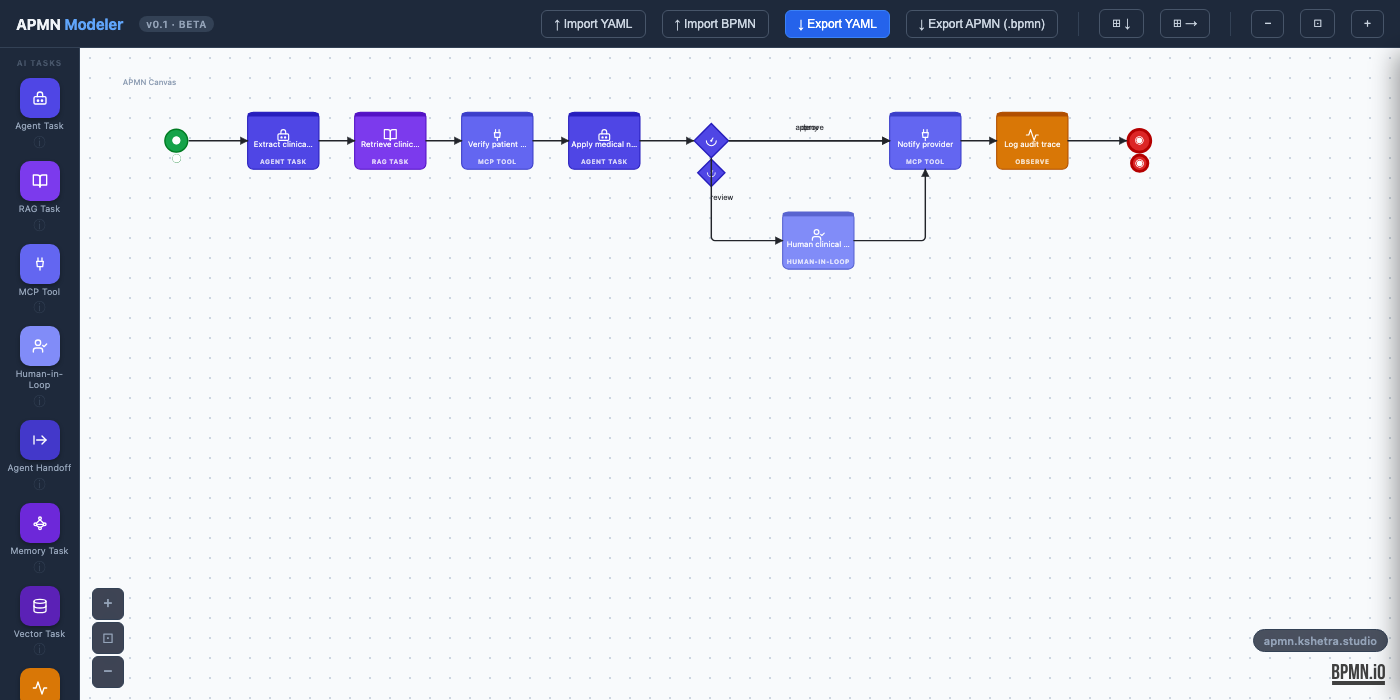
A ragTask pulls relevant clinical criteria from the insurer's policy knowledge base before any AI assessment runs. An mcpToolTask calls the insurer's eligibility API to confirm current coverage. task_assess_request then runs the AI assessment and returns a determination with a confidence score.
gw_auth_confidence routes on confidence:
- Above 0.90: preliminary approval routes to
humanInLoopTaskwhere a clinician confirms before any authorisation is issued. No authorisation goes out without clinical sign-off regardless of AI confidence. - Between 0.65 and 0.90: a human authorisation specialist reviews the AI assessment and makes the final determination.
- Below 0.65:
task_manual_authruns the Scenic Route human process as if no AI had been involved.
The humanInLoopTask carries a two-hour response window. If the reviewing clinician does not respond, the escapeGate fires and the request routes to specialist review automatically, so no authorisation is ever delayed because a reviewer was unavailable.
An observeEvent logs every AI determination alongside the final human decision, capturing every recommendation, every confidence score, every human override, and every outcome in a structured, timestamped record. This is a first-class node in the APMN diagram, not a compliance afterthought.
What the clinical governance committee can see:
- Does AI make clinical decisions? No. A clinician or specialist confirms or overrides before any authorisation is issued.
- What happens when AI confidence is low? The request routes to the manual process as if AI had not been involved.
- What happens if the reviewing clinician does not respond? A two-hour timeout fires automatically, with no patient waiting because of a non-responsive reviewer.
- Is every AI recommendation logged? Yes. Every determination and every human response is captured by
observeEventand available for audit. - Can the committee adjust confidence thresholds? Yes. Thresholds are properties of the
confidenceGatein the APMN source, set by the committee and enforced in the compiled execution.
Why Full Greenfield Replacement Is Not the Near-Term Conversation
Healthcare's Horizon 3 and Horizon 4 look different from FSI's: not absent, but more bounded.
Horizon 3 in healthcare means AI-first handling of routine, protocol-driven processes where clinical criteria are fully documented and AI is executing a defined protocol rather than exercising judgment: routine chronic disease management reviews, standard vaccination eligibility checks, prescription renewal for stable conditions against documented protocols.
Horizon 4 in healthcare is the self-improving documentation and administrative layer, not the self-improving clinical decision layer. The modelVersionGate runs A/B tests on documentation quality and authorisation accuracy rather than diagnostic outcomes.
The clinical judgment layer will move to Horizon 3 and Horizon 4 on a longer timeline, as evidence accumulates, regulatory frameworks develop, and clinical governance structures build the experience needed to oversee AI at that level of responsibility. APMN supports this timeline because the notation does not prescribe how fast an organisation moves across horizons; it provides the governed design layer that makes movement possible at whatever pace the organisation's risk appetite and regulatory environment allows.
Section 5: From Diagram to Execution
The Same Source, Two Altitudes
The governance conversations described above produce decisions: confidence thresholds, escape gate conditions, HITL timeout windows, audit trail requirements, boundary conditions. These decisions belong in the APMN source, not in a requirements document that drifts from the implementation, not in a developer's memory, and not in a PowerPoint that was accurate when it was presented.
The APMN source is the single artefact that carries the governed design from the boardroom to the execution framework. The same file that the risk committee reviewed and approved compiles directly to deployment-ready orchestration code, so what the board approved is what runs.
TwinTrack produces a governed scaffold rather than finished production code: the graph structure, routing logic, node connections, confidence threshold conditions, escape gate handlers, and HITL interrupt points, all derived directly from the APMN source. The developer implements the detail inside nodes the diagram has already positioned, connected, and bounded, without needing to re-derive intent from a requirements document or guess at what the risk committee decided about threshold values.
Compiling to LangGraph
LangGraph models agentic workflows as directed graphs with typed state. An APMN workflow compiles to LangGraph as follows:
- Nodes to graph nodes. Each APMN task node becomes a typed Python function. The developer implements the function body and the graph structure is already in place.
- Flow definitions to edges. The routing is defined in the compiled output; the developer does not decide which nodes connect to which.
- Confidence gates to conditional edges. The
confidenceGatecompiles to a conditional edge with routing logic that evaluates the confidence float from the upstream node. The threshold values from APMN become the conditions, so a committee that negotiated 0.92 sees that threshold enforced without additional developer configuration. - Escape gates to supervisor nodes. Any failure, timeout, or sub-threshold result on a watched node triggers the escape handler automatically.
- Human-in-loop tasks to interrupt points. Timeout duration and escalation target come from the APMN source; the HITL interface is an implementation detail.
- Observe events to telemetry hooks. Each
observeEventcompiles to a structured logging call that the developer connects to the organisation's chosen observability platform.
Compiling to Orkes Conductor
Orkes Conductor models workflows as JSON definitions executed by a distributed worker fleet. An APMN workflow compiles to Orkes as follows:
- Nodes to task definitions with appropriate task types: SIMPLE, HTTP, HUMAN, or AI_TASK.
- Confidence gates to SWITCH tasks with threshold conditions from the APMN source.
- Escape gates to event handlers watching defined tasks for failure or timeout.
- Human-in-loop tasks to HUMAN tasks with SLA definitions, with timeout duration and escalation path from the APMN source.
- Observe events to workflow metadata captured in the Conductor execution and available via API.
The Reverse Compiler: Visualising What Already Exists
The compilation path runs from APMN to execution framework. Many enterprise teams, however, start in the opposite direction: they have existing LangGraph workflows built by developers, running in production, with no visual representation the governance committee can read.
TwinTrack's reverse compiler addresses this directly. An existing LangGraph StateGraph is parsed, node types and routing logic are classified against the APMN specification, and an APMN diagram is generated that represents the workflow's governance structure visually. interrupt() calls become humanInLoopTask nodes, retriever invocations become ragTask nodes, external HTTP calls become mcpToolTask nodes, and LLM invocations become agentTask nodes.
The result is a governance-readable representation of what the workflow actually does rather than a perfect reconstruction of the original developer's intent. It is the bridge for teams that have already built in LangGraph and now need to bring their workflows into an enterprise governance process. The developer does not rebuild from scratch; the reverse compiler closes the gap between what was built and what governance requires.
Try it: bpmn2ai.kshetra.studio/visualise
Section 6: The Governance Conversation
The Questions Every Risk Committee Asks
Across financial services and healthcare, governance committees ask variations of the same questions before approving any AI deployment. What follows is each question, the answer a programme team typically gives without APMN, and the answer APMN makes possible.
Where exactly does AI make a decision?
Without APMN: A process diagram and a separate technical document that were in sync when written but have drifted since. The committee cannot tell from either which nodes involve AI judgment and which involve deterministic logic.
With APMN: Every agentTask, ragTask, and confidenceGate is visually distinct. A committee member can point to any node and ask whether it is AI or deterministic, and the answer is in the node type.
What happens when AI confidence is insufficient?
Without APMN: The team explains there is a confidence threshold, but the committee cannot see the value, verify the routing logic, or confirm enforcement.
With APMN: The confidenceGate node has explicit threshold properties and three routing paths are shown. Threshold values are in the APMN source, in version control, alongside the committee resolution that set them. The committee negotiates the threshold in the meeting and it is enforced in the compiled execution.
What is the fallback when something goes wrong?
Without APMN: A verbal description of a fallback mechanism, with no visibility on which failure modes are covered or how quickly the fallback fires.
With APMN: The escapeGate node is explicit, watched nodes are listed, trigger conditions are defined, and the fallback target is a named node. For every AI node in the workflow, the committee can see whether it is covered by an escape gate and what the fallback is.
Where does human oversight sit and what are its constraints?
Without APMN: Confirmation that humans are involved, with no visibility on sequence, optionality, timeout, or escalation.
With APMN: The humanInLoopTask position, timeout duration, and escalation target are all explicit. A General Counsel can ask what happens if the reviewing clinician is on leave and the diagram answers: a two-hour timeout fires automatically, the case routes to specialist review, and no patient is delayed.
How do we know the AI is performing as expected after go-live?
Without APMN: A commitment to build monitoring after deployment, with no visibility into what will be monitored or what triggers a governance review.
With APMN: observeEvent nodes are designed in from the first diagram. The committee can see what is logged, at which points, and to which platform. Monitoring requirements specified during governance approval become observeEvent node specifications in the APMN source and are part of what is compiled.
How do we change the risk parameters if the business environment changes?
Without APMN: Parameter changes require a change request, a development sprint, testing, and redeployment. The committee approves with discomfort about their ability to respond quickly to changing conditions.
With APMN: Changing a threshold is a change to the APMN source, reviewed and approved by the committee, then recompiled. The turnaround is measured in days rather than sprints. The modelVersionGate allows new model versions to be evaluated against live traffic without a full redeployment.
Who is accountable when something goes wrong?
Without APMN: The accountability structure is implied but not documented in the workflow design, requiring reconstruction after the fact from logs and recollections.
With APMN: The APMN source is version-controlled with every governance decision timestamped and attributed. When something goes wrong, the first question is not "what did we agree?" but "what does the APMN source say, when was it last changed, and who approved that change?"
The Threshold Negotiation: A Governance Meeting in Practice
The risk committee is reviewing the Horizon 2 mortgage origination workflow with the APMN diagram on the screen. The Chief Risk Officer points to the confidenceGate on the affordability pre-screening node, where the threshold is set at 0.85.
She asks on what basis 0.85 was chosen and what the distribution of confidence scores looks like in the pilot data.
The observeEvent data from Horizon 1 shows that 94% of cases scored above 0.92, 4% scored between 0.85 and 0.92, and 2% scored below 0.85. Three cases in the medium band had material errors that the human reviewer caught.
The CRO proposes raising the high-confidence threshold to 0.90 and requiring specialist rather than generalist review for the medium-confidence band. The committee agrees. The APMN source is updated in the meeting, the change is in version control with the committee resolution attached, and the next compilation reflects it.
The whole exchange takes twenty minutes and produces a specific, evidence-based, documented decision. The developer does not need to interpret what the committee decided because the APMN source tells them exactly what changed.
Getting Started
APMN is open source. The specification is available under Apache 2.0. The visual modeller is available under MIT. Both are free to use, fork, and build on. No registration required.
Pick one process. One sub-use case. One node where AI could assist a human who currently does the work manually. Draw it in the APMN modeller. Set a conservative confidence threshold. Show it to your risk committee. That is Horizon 1. Everything else follows from there.
- Try TwinTrack at bpmn2ai.kshetra.studio - free tier, no registration required
- Read the spec at apmn.kshetra.studio/spec/apmn-v0.1
- Use the modeller at apmn-modeler.kshetra.studio
- Join the community at github.com/kshetra-studio/apmn
The Scenic Route will always be there. The Express Lane is ready when you are.
Appendix
A: APMN Node Type Reference
| Node Type | BPMN Base | Purpose | Cost Profile |
|---|---|---|---|
agentTask |
serviceTask | LLM performs reasoning or judgment | High - frontier model |
ragTask |
serviceTask | Retrieve context before reasoning | Medium - retrieval + smaller model |
mcpToolTask |
serviceTask | Invoke external tool via MCP protocol | Low - deterministic API call |
humanInLoopTask |
userTask | Structured human oversight of AI output | Human time - no model cost |
manualTask |
manualTask | Physical or non-automatable action | Human time - no model cost |
confidenceGate |
exclusiveGateway | Route on AI confidence score | No cost - routing only |
escapeGate |
eventBasedGateway | Automatic fallback on failure, timeout, or low confidence | No cost - structural safety net |
agentHandoff |
callActivity | Delegate to specialist sub-agent | High - additional model invocation |
modelVersionGate |
exclusiveGateway | A/B test model versions in production | No cost - routing only |
memoryTask |
serviceTask | Persist or retrieve agent context across turns | Low - storage operation |
observeEvent |
intermediateEvent | Structured observability and audit hook | Negligible - logging only |
B: Resources
| Resource | URL |
|---|---|
| APMN Specification v0.1 (Apache 2.0) | apmn.kshetra.studio/spec |
| APMN Visual Modeller (MIT) | apmn-modeler.kshetra.studio |
| TwinTrack Compiler (BPMN to APMN to LangGraph / Orkes) | bpmn2ai.kshetra.studio |
| LangGraph Reverse Compiler | bpmn2ai.kshetra.studio/visualise |
| APMN Articles | apmn.kshetra.studio/articles |
| GitHub | github.com/kshetra-studio/apmn |
C: About the Author
Dinesh Singh Panwar is the founder of Kshetra Studio Pty Ltd and the creator of the APMN specification. He served as Head of Technology and Chief Engineer at Westpac Group from 2021 to 2026, leading large-scale technology transformation programmes across one of Australia's largest financial institutions. He is a two-time GSDC International Keynote Speaker, a panel member at the Clutch Events AppSec and DevSecOps Summit, and a published author in The Security Digest. APMN was created to solve a problem he observed firsthand across enterprise AI programmes: the absence of a governed design layer that bridges business approval and technical execution.
Kshetra Studio Pty Ltd (ACN 698 962 604) - Sydney, Australia - kshetra.studio