The Agentic AI Juggernaut Stalled at the Enterprise Gate.
To make this concrete, we walk through a real enterprise workflow: sales document ingestion with PII redaction. The problem it illustrates is not specific to sales teams or an industry. It shows up in every agentic workflow that has ever been proposed and never made it past a governance review for enterprise scale implementation
The Gap Nobody Talks About
AI engineers are building sophisticated agentic workflows. Greenfield orchestration blueprints in LangGraph. Brownfield migration plans that wrap existing CRM and ECM systems with intelligent retrieval layers. The execution frameworks are mature. LangChain, LangGraph, Orkes Conductor are production-ready. The capability exists.
And then it hits the enterprise boundary.
Not because the technology is wrong. Because the artefact is wrong.
A board does not approve Python. A risk committee does not approve LangGraph node definitions. A Chief Compliance Officer does not approve YAML. Enterprise decision makers approve process flows. They approve structured abstractions that show sequencing, decision points, human oversight, and risk controls at a level they can read, question, and put their name to.
The AI engineer has a detailed execution blueprint. The board has a governance requirement. There is no shared language between them. So the agentic workflow sits in a proof of concept. It demonstrates well in a sandbox. It never reaches production.
That is why the agentic AI juggernaut has stalled at the enterprise boundary. Not capability. Not cost. Not risk appetite. A missing artefact.
This article uses a real enterprise workflow, sales document ingestion with PII redaction, to show what that missing artefact looks like, and why APMN is the notation that provides it.
The Business Problem
Your sales team generates documents constantly. Proposals, contracts, email threads, Salesforce attachments, shared drive files. Some contain customer PII: names, email addresses, phone numbers, financial account numbers, government IDs. Your organisation wants to vectorise that content for AI-powered knowledge retrieval so sales reps can search the entire document history and get relevant answers instantly.
The business case is clear. The compliance question is equally clear, and it has to be answered before a single document is vectorised: how do you guarantee that PII never reaches the vector store unredacted?
This is not a question the AI engineer needs answered. They know how to write a redaction function. The question is for the board, the risk committee, and the data governance officer. They need to see, in a form they can evaluate and sign off, that the ordering is correct. Redact first. Vectorise second. Always. With no path through the workflow that bypasses that sequence.
If that ordering is enforced in code but invisible to the people who must approve it, the approval never happens. Or it happens on the basis of a PowerPoint that drifted from the implementation three sprints ago.
APMN solves this by making the ordering visible, structured, and executable from the same source.
What the Board Needs to See
Before any technical discussion, consider what a Chief Risk Officer or a data governance committee actually needs in order to approve this workflow for production.
They need to know:
- What triggers the workflow and what data enters it
- At what point is PII detected and by what mechanism
- What happens when detection is uncertain, and who decides
- What is the guaranteed ordering between detection, redaction, and vectorisation
- What happens when any step fails
- Who is notified when the system cannot proceed automatically
- How is every exception logged and tracked
A LangGraph Python file answers all of these. But not in a form a risk committee can read in a governance meeting. Not in a form that can be version-controlled alongside a board resolution. Not in a form where a compliance officer can point to a specific node and say: this is the gate I required, and this is where it sits in the sequence.
APMN answers all of the same questions in a visual process notation that enterprise decision makers already understand. The same source then compiles directly to LangGraph scaffolding. The diagram the board approves and the code that runs in production are the same artefact at different altitudes.
The APMN Workflow
Below is the APMN process flow for the sales document ingestion and PII redaction pipeline.
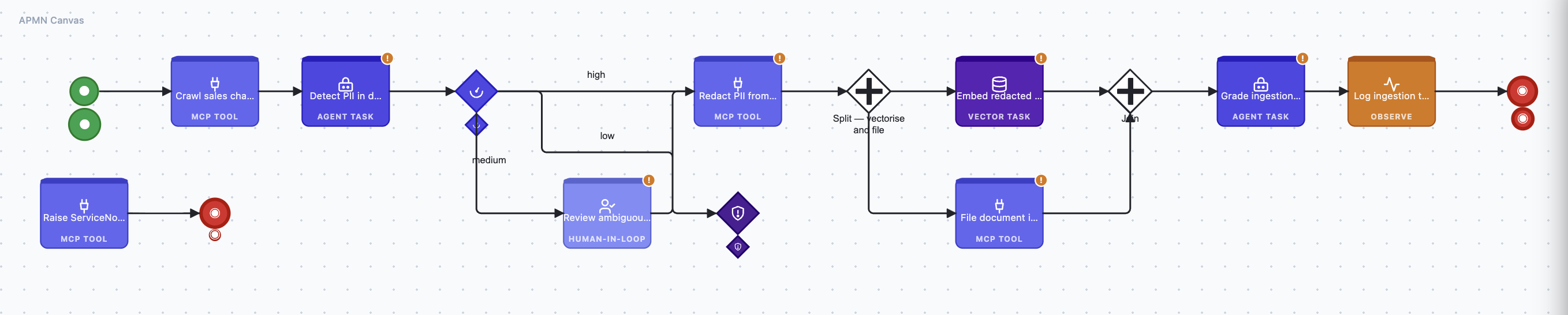 View APMN YAML source and interactive build to LangGraph or Orkes
The flow reads left to right. Every node type is drawn from the APMN v0.1 specification. The visual notation is BPMN-compatible, meaning any enterprise architect, BA, or process owner who has worked with Appian, IBM BPM, Pega, or Camunda can read this diagram without training.
What they will see that they have never seen in a standard BPMN diagram are the AI-native constructs: the confidenceGate, the escapeGate, and the humanInLoopTask. These are not cosmetic additions. They are the notation that makes probabilistic AI steps visible and governable at design time.
Walking the Board Through the Flow
Step 1: Document Detection and Ingestion
A new document is detected in a sales channel. An mcpToolTask node (task_crawl_source) pulls the raw document from wherever it lives: CRM attachment, email thread, shared drive. The raw document is never indexed. The flow connects directly to PII detection.
This is the first thing a compliance officer needs to see: the raw document has one outgoing path and it goes to detection, not to storage or retrieval.
Step 2: PII Detection with Confidence Scoring
task_detect_pii runs a language model against the raw document. It returns two things: a list of detected PII spans and a confidence score for detection completeness.
This is where the board conversation gets interesting. The model does not return a binary yes or no. It returns a probability. Detection might be 94% confident. Or 71% confident. Or 45% confident. Each of those outcomes requires a different response.
That is what the confidenceGate is for.
Step 3: The Confidence Gate (Where Risk Management Becomes Visible)
The confidenceGate node (gw_pii_confidence) evaluates the detection confidence score and routes the workflow accordingly:
- Above 0.9: Detection is reliable. Proceed directly to redaction.
- Between 0.6 and 0.9: Detection is uncertain. A human data governance reviewer must confirm or correct the flagged spans before redaction proceeds.
- Below 0.6: Detection confidence is too low to act on. The document does not proceed. A ServiceNow exception ticket is raised immediately.
A risk committee reading this diagram can see, at a glance, that the workflow has three defined responses to probabilistic output. There is no path where a low-confidence detection silently proceeds to redaction. There is no path where an uncertain result proceeds without human review. The thresholds are visible in the diagram. The routing is explicit. This is what it means to make probabilistic AI steps governable.
The board can negotiate these thresholds. Is 0.9 the right high-confidence cutoff, or should it be 0.95 for financial documents? Is a four-hour human review window appropriate, or does the data governance team need 24 hours? These are governance decisions. They belong in the APMN source, set by the people accountable for them, enforced in the compiled output.
Step 4: Human Review with Time Boundary
When detection confidence falls between 0.6 and 0.9, a humanInLoopTask node (task_human_review_pii) routes the document to a data governance reviewer. The reviewer sees the flagged spans, confirms or corrects them, and the workflow proceeds to redaction with validated PII annotations.
The node has a four-hour timeout with escalate_to: gw_escape. If the reviewer does not respond within four hours, the document does not proceed. The escape gate fires. A ServiceNow ticket is raised.
This is the second thing a compliance officer needs to see: human review is not optional and it is not open-ended. It is time-bounded and the consequence of non-response is defined and automatic.
Step 5: Redaction
task_redact_pii produces a PII-clean copy of the document. The original document with PII intact is never passed to any downstream node. The node documentation states this explicitly: "Produces a PII-clean copy. Original is never indexed or vectorised."
Step 6: Parallel Processing of the Redacted Document
After redaction, the workflow splits into two parallel streams. The redacted document is embedded into the sales_knowledge_base vector store. Simultaneously it is filed in the enterprise content management system with a retention policy applied.
Only the redacted copy enters either stream. The parallel split comes after redaction. There is no flow connection from any pre-redaction node to the vector store. The graph topology enforces this. A developer cannot accidentally create a shortcut without modifying the APMN source, which is visible in version control.
Step 7: Quality Grading
A grader agent (task_grade_quality) runs after the parallel join. It verifies chunk coherence in the vector store and confirms ECM filing metadata is complete: title, source, retention class. This is the equivalent of LangChain's grader node in the Agentic RAG pattern. The workflow does not declare success until the retrieval corpus is confirmed usable.
Step 8: The Escape Gate
An escapeGate (gw_escape) watches five nodes throughout the entire workflow: task_detect_pii, task_redact_pii, task_vectorise, task_file_ecm, and task_grade_quality. Any failure, timeout, or result below a 0.6 confidence floor raises a ServiceNow ticket via task_raise_snow_ticket rather than failing silently.
This is the third thing a compliance officer needs to see: there is no silent failure mode. Every exception surfaces. Every exception is tracked.
The Executive Conversation This Diagram Enables
The APMN diagram is not just a technical specification. It is a negotiation surface.
A Chief Data Officer reviewing this flow can point to gw_pii_confidence and ask: who set the 0.9 threshold, and on what basis? The answer belongs in the APMN source as a documented annotation, not in a developer's memory.
A General Counsel can point to task_human_review_pii and ask: what happens if the reviewer is on leave and nobody else picks up the ticket in four hours? The answer is visible in the diagram: the escape gate fires, a ServiceNow ticket is raised, the document does not proceed. That answer satisfies a legal question without requiring a conversation with the engineering team.
A risk committee can ask: show me every node where the AI makes a probabilistic decision. The answer is: one. task_detect_pii. Every other gate is either a deterministic condition or an external tool call. The scope of AI judgment is clearly bounded.
These conversations happen before a line of production code is written. They produce decisions that belong in the APMN source. When those decisions change, they change in one place, the APMN file, and the compiled output reflects them automatically.
From Diagram to Execution
The same APMN source that the board reviews compiles directly to LangGraph Python scaffolding via TwinTrack.
The flow definitions become graph edges. The confidenceGate becomes a conditional routing function evaluating the confidence float from task_detect_pii.output.confidence. The escapeGate becomes a supervisor node watching for failures across the five monitored nodes. The humanInLoopTask becomes an interrupt point with a timeout escalation handler. The parallel split becomes a LangGraph fork with a synchronisation barrier at the join.
The developer receives a working scaffold. They do not re-derive the intent of the workflow from a requirements document. They implement the detail inside nodes that the diagram has already positioned, connected, and bounded.
When the compliance officer asks to see the production workflow, they see the same diagram. The diagram did not become a fiction the moment development started. It is the source.
What This Changes for Enterprise Agentic Adoption
The agentic AI juggernaut has not stalled because enterprises are slow or risk-averse. It has stalled because the artefact that enterprise governance processes require, a readable, auditable, executable process specification with explicit risk controls, has not existed for agentic workflows.
LangGraph is a brilliant execution framework. It is not a governance artefact. Orkes Conductor is a powerful orchestration engine. It is not a board-level sign-off document.
APMN is the missing layer. It sits between the business decision and the execution framework. It speaks the visual language that enterprise decision makers trust. It carries the AI-native constructs that make probabilistic steps explicit and governable. And it compiles to the execution frameworks that developers are already using.
The gates open when the board can see what they are approving. APMN is how they see it.
APMN specification v0.1 (Apache 2.0): apmn.kshetra.studio/spec/apmn-v0.1 BPMN mapping reference: apmn.kshetra.studio/spec/bpmn-mapping Visual modeler: apmn-modeler.kshetra.studio TwinTrack compiler: bpmn2ai.kshetra.studio GitHub: github.com/kshetra-studio/apmn